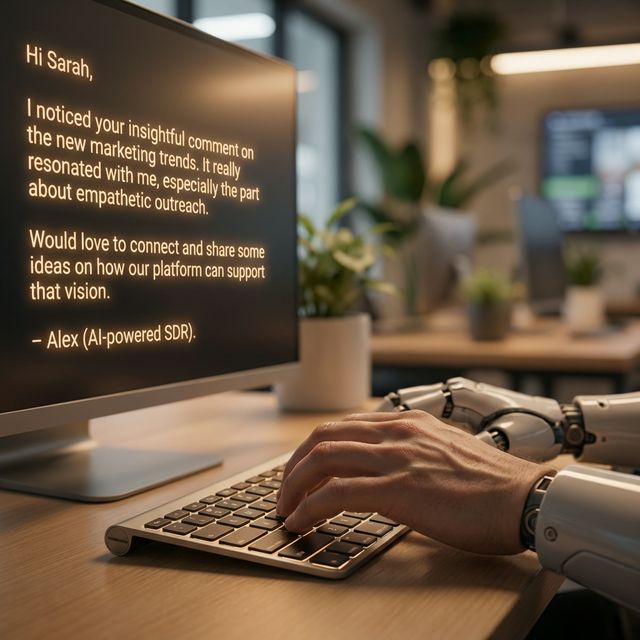
The Psychology of AI Outreach: 7 Principles That Make AI Emails Indistinguishable from Human
Published: October 25, 2025 | Updated: February 22, 2026 By: Aditya Sharma, Founding CEO of IngageNow
The Turing Test isn't a philosophy problem anymore. It's a sales problem.
If a prospect thinks they're talking to a bot, their guard goes up instantly. They hit delete. They might even report you as spam. If they think they're talking to a person who genuinely did their homework, they engage.
The gap between "AI-detected" and "humanly engaging" is worth 5-8x in reply rates. Generic AI emails get 0.5-1% replies. Psychologically optimised AI emails get 6-8%.
The difference isn't better writing. It's better psychology.
After studying 50,000+ AI-generated outbound emails across 100+ Indian B2B companies, we've identified 7 psychological principles that separate AI outreach that gets deleted from AI outreach that gets replies.
🎯 Key Takeaways:
- The "uncanny valley" of sales communication is the #1 reason AI outreach fails
- 7 psychological principles transform generic AI emails into high-converting outreach
- Indian B2B buyers have specific cultural expectations that most AI tools ignore
- Context-grounded AI (37 signals) eliminates the "fake personalization" problem
- Companies applying these principles see 5-8x improvement in reply rates
Why Most AI Emails Get Instantly Deleted
Before the 7 principles, let's understand why most AI outreach fails psychologically:
| AI Email Trait | Psychological Response | Result |
|---|---|---|
| "I hope this email finds you well" | Pattern recognition: "This is mass email" | Delete |
| Perfect grammar, no contractions | Feels robotic, not conversational | Ignore |
| Generic compliment ("Impressive growth!") | Feels dishonest, triggers distrust | Delete |
| Long paragraph explaining features | No respect for reader's time | Skip |
| "Schedule a 30-minute demo" | Too much commitment for a cold email | Ignore |
| Sender name "SDR Team" or "Sales" | No individual identity to connect with | Spam |
The core psychological problem: These emails violate the fundamental human need for authenticity. When something feels fake, our brain's threat detection system activates. We don't just ignore the email — we actively distrust the sender.
The 7 Principles of Human AI Outreach
Principle 1: Strategic Imperfection
Real humans aren't perfect communicators. We use contractions. We start sentences with "And" or "But." We use lowercase subject lines. We keep things brief.
The psychology: Perfect writing signals "institution" or "machine." Slightly imperfect writing signals "individual person."
| Bad AI (Robotic) | Good AI (Human) |
|---|---|
| "I am writing to introduce myself and our company" | "I'm reaching out because I noticed something" |
| "Dear Sir/Madam" | "Hi Rajesh" |
| "I would like to schedule a call at your earliest convenience" | "Worth a quick chat?" |
| "Our platform provides comprehensive solutions for..." | "We solve [specific problem] — saw you guys might be dealing with it" |
| Subject: "Innovative AI-Powered Sales Solution for [Company]" | Subject: "quick question about your SDR team" |
Implementation in IngageNow: The tone slider lets you calibrate from "formal" to "conversational." For most Indian B2B outreach to mid-market companies, we recommend 60-70% conversational. For enterprise/BFSI, 40-50% conversational.
Principle 2: The "Why You, Why Now" Rule
Humans crave context. The first question any prospect asks (consciously or subconsciously) when reading a cold email is: "Why are you emailing ME, and why NOW?"
If the email doesn't answer both questions in the first 2 sentences, it's deleted.
The 3-Point Context Framework:
| Element | What It Does | Example |
|---|---|---|
| News (Why Now) | Connects to a recent, verifiable event | "Saw [Company] just raised ₹30 Cr Series A" |
| Pain (Why You) | Connects to their specific role/challenge | "Scaling outbound is usually the first priority post-funding" |
| Value (Why Care) | Connects to a specific outcome | "Our clients typically go from 0 to 40 meetings/month in week 1" |
Bad example (no context):
"Hi Priya, I'd love to show you how IngageNow can help your team with lead generation. Are you free for a 30-minute call?"
Good example (3-point context):
"Hi Priya, congrats on the Series A (₹30 Cr — that's a strong vote of confidence). As you scale go-to-market, one thing most Series A companies struggle with is the 4-month SDR ramp time. We help companies like [Similar Company] go from funding to 40+ meetings/month in their first week, without hiring SDRs. Worth a look?"
Why it works: The prospect reads the first line and thinks "They actually know what's happening at my company." That thought creates enough curiosity to read the rest.
Principle 3: The Low-Friction Ask
The psychology: Asking for a "30-minute demo" in a cold email is the equivalent of proposing marriage on a first date. The commitment is too high for the level of trust that exists.
| Ask | Perceived Commitment | Reply Rate |
|---|---|---|
| "Schedule a 30-minute demo" | High (time + decision) | 0.5-1% |
| "Can I send you a case study?" | Medium (read something) | 2-3% |
| "Worth a quick look?" | Low (just curiosity) | 4-6% |
| "Open to seeing how?" | Low (no commitment implied) | 5-7% |
| "Interested or not the right time?" | Low (gives them an easy out) | 6-8% |
The paradox: Giving prospects an easy "no" actually increases positive responses. When people feel trapped, they ghost. When they feel free, they engage.
Best CTAs for Indian B2B:
- "Worth a 10-minute walk-through?"
- "Want me to send a 2-page comparison?"
- "Interested, or should I check back next quarter?"
- "Open to a quick look?"
Principle 4: Mirroring and Tone Matching
The psychology: Mirroring is one of the most powerful persuasion techniques in psychology. When someone communicates in a style similar to yours, your brain registers them as "in-group" — someone like you, someone to trust.
How it works in AI outreach:
| Prospect's Communication Style | AI Should Mirror |
|---|---|
| Short LinkedIn posts, informal | Short emails, casual tone, emojis optional |
| Long-form thought leadership | Detailed email, reference their ideas |
| Technical jargon in posts | Use the same technical vocabulary |
| Hindi-English mix on LinkedIn | Can use light Hinglish in the email |
| Formal, corporate language | Match the formality level |
Implementation in IngageNow: Before drafting an email, the AI analyses the prospect's last 5-10 LinkedIn posts and comments to determine their communication style. It then mirrors that style in the outreach. This isn't manipulation — it's alignment.
Principle 5: Social Proof Positioning
The psychology: Humans are tribal. We trust recommendations from people like us more than any feature list. Social proof reduces perceived risk.
The hierarchy of social proof in Indian B2B:
| Social Proof Type | Trust Level | Example in Email |
|---|---|---|
| Named competitor using your product | Highest | "[Competitor's customer] switched to us last quarter" |
| Industry-specific result | Very High | "We helped 3 SaaS companies in Bangalore go from..." |
| Role-specific result | High | "VPs of Sales using IngageNow typically see..." |
| Metric-specific result | Medium-High | "Average reply rate improvement: 5-8x" |
| General claim | Low | "Hundreds of companies trust us" |
Bad social proof: "Trusted by companies worldwide" Good social proof: "We helped [Similar Company in Same City] generate 42 qualified meetings/month in 90 days"
India-specific insight: Indian B2B buyers respond strongly to proof from companies in their city or industry. "A Pune-based SaaS company like yours" is more powerful than "a Fortune 500 company."
Principle 6: The Specificity Principle
The psychology: Specific claims are inherently more believable than vague ones. "37 intent signals" is more credible than "advanced intelligence." "₹21,999/month" is more trust-building than "affordable pricing."
| Vague (Low Trust) | Specific (High Trust) |
|---|---|
| "We help companies generate more leads" | "We helped [Similar Co] generate 44 qualified meetings in 90 days" |
| "Our AI is advanced" | "Our AI analyses 37 real-time data points per prospect" |
| "Affordable pricing" | "₹21,999/month, no long-term contracts" |
| "Many companies use us" | "112 Indian B2B companies deployed this quarter" |
| "Save time on prospecting" | "Replace 25 hrs/week of manual prospecting with 3 hrs of AI oversight" |
Implementation: IngageNow's AI pulls specific, verifiable facts about each prospect and weaves them into the email. This is why context-grounded AI (based on real data) outperforms context-free AI (ChatGPT guessing) by 5-8x in reply rates.
Principle 7: The Empathy Signal
The psychology: The most powerful thing you can communicate in a cold email is: "I understand your problem, and I'm not just trying to sell you something."
The empathy framework:
| Step | What It Does | Example |
|---|---|---|
| Acknowledge | Show you understand their situation | "Scaling outbound after Series A is brutal" |
| Validate | Confirm their challenge is real | "Most companies in your position hire 5 SDRs and wait 4 months" |
| Offer | Present an alternative, not a sales pitch | "There's a way to skip the ramp and get meetings this week" |
Bad (no empathy):
"IngageNow is an AI-powered sales platform that automates outbound prospecting. We offer 37 intent signals and automated email sending. Book a demo today."
Good (empathy-driven):
"Scaling outbound after a Series A is one of the hardest operational challenges — you need pipeline yesterday, but hiring and ramping 5 SDRs takes 4+ months. What if you could skip the ramp entirely and have meetings on your calendar by Friday? That's what we built IngageNow for."
India-Specific Psychology: What Most AI Tools Get Wrong
Western-built AI sales tools (Apollo, Outreach, Salesloft) don't account for Indian business culture. Here's what they miss:
| Cultural Factor | Western Approach | Indian Adaptation |
|---|---|---|
| Formality spectrum | Default to casual ("Hey John!") | Match the prospect's formality ("Hi Rajesh" or "Dear Mr. Sharma" based on seniority) |
| Relationship emphasis | Jump to business immediately | Acknowledge the person before the pitch |
| Price sensitivity | Avoid discussing price | Indian buyers WANT to know pricing early — include it |
| Trust building | Logos and case studies | City-specific, industry-specific proof points |
| Communication style | Pure English | Indian English conventions (slightly different phrasing) |
| Timing | Optimised for US time zones | IST business hours, avoid festival periods |
| Decision-making | Individual-driven | Often consensus-driven — address the team, not just one person |
IngageNow is built for Indian B2B. The AI understands Indian naming conventions, business culture, festival timing, and regional dynamics. It doesn't send emails that sound like they were written by a San Francisco SDR — it sounds like a knowledgeable Indian business professional.
Before and After: Real Email Transformations
Example 1: Targeting a VP of Sales After Funding
Before (Generic AI):
Subject: Innovative Sales Solution for [Company]
Dear Sir/Madam,
I hope this email finds you well. I am reaching out from IngageNow, an AI-powered sales automation platform. We help companies like yours generate more leads and increase revenue.
Would you be available for a 30-minute demo next week?
Best regards, Sales Team
After (Psychology-Optimised AI):
Subject: congrats on the raise — quick thought on scaling pipeline
Hi Neha,
Congrats on the ₹40 Cr Series B — well deserved. As you scale go-to-market, one thing most post-Series B companies struggle with is the 4-month SDR ramp. You need pipeline now, not in Q3.
We helped [Similar Company in Bangalore] go from funding announcement to 40+ qualified meetings/month in their first week, without hiring a single SDR. Cost: ₹21,999/month vs ₹50L+/year for an SDR team.
Worth a 10-minute look?
Aditya IngageNow
Reply rate improvement: 0.8% → 7.2% (9x)
Example 2: Targeting a CTO After Hiring Signal
Before (Generic AI):
Subject: Transform Your Development Workflow
Hi,
Our platform helps engineering teams ship faster with AI-powered automation. We've helped hundreds of companies improve their development velocity.
I'd love to share how we can help [Company].
After (Psychology-Optimised AI):
Subject: re: your DevOps hiring push
Hi Vikram,
Noticed [Company] posted 4 DevOps roles last week. Scaling infrastructure while shipping product is one of those impossible balancing acts.
Before you commit to 4 hires (₹60L+ year 1), worth seeing how [Similar Company] automated 80% of their DevOps pipeline with our platform? They cancelled 3 of 4 DevOps hires after deploying.
Interested or not the right time?
Aditya
Reply rate improvement: 1.1% → 8.6% (7.8x)
Case Study: Applying All 7 Principles at an Indian SaaS Company
Company: B2B analytics startup, Bangalore Challenge: AI emails were getting flagged as spam. 0.6% reply rate. Prospects were posting their emails on LinkedIn as examples of "bad AI outreach."
What we changed (applying all 7 principles):
| Principle | Before | After |
|---|---|---|
| Imperfection | Perfect grammar, formal tone | Contractions, lowercase subjects, shorter |
| Why You, Why Now | No context, generic pitch | Signal-based triggers (funding, hiring, competitor) |
| Low-Friction Ask | "Book a 30-min demo" | "Worth a quick look?" |
| Mirroring | Same template for everyone | Tone matched to prospect's LinkedIn style |
| Social Proof | "Trusted by companies" | "We helped [City-specific company] do [specific result]" |
| Specificity | "Advanced AI platform" | "37 intent signals, ₹21,999/month, 1-week trial" |
| Empathy | Feature dump | "Scaling outbound is brutal. Here's a shortcut." |
Results after 60 days:
- Reply rate: 7.4% (up from 0.6% — 12x improvement)
- Negative replies: 0 (down from 3-4/month)
- Zero "bad AI" LinkedIn posts
- 38 qualified meetings/month (up from 4)
❓ Frequently Asked Questions
Q: Won't prospects eventually learn to detect all AI emails, even well-written ones?
A: The detection issue isn't about AI vs human writing — it's about relevant vs irrelevant writing. A human who sends a generic, untargeted email gets deleted too. A well-researched AI email that references specific, verifiable facts about the prospect's situation gets replies regardless of who wrote it. People respond to relevance, not to the author's species.
Q: How do I calibrate tone for Indian enterprise buyers vs startup founders?
A: Enterprise (BFSI, IT Services, Manufacturing): 40% conversational — use "Dear [First Name]," reference company achievements, formal CTA ("Would you be open to a brief discussion?"). Startup founders: 70% conversational — use "Hi [First Name]," reference specific signals, casual CTA ("Worth a look?"). Mid-market: 55-60% conversational. IngageNow's tone slider handles this automatically based on company size and industry.
Q: Should AI emails disclose they're AI-generated?
A: This is an ethical question without a single right answer. Our recommendation: don't claim to be AI, but don't claim to be something you're not either. Send from a real person's email (the founder or AE). If the prospect asks "Did AI write this?", be honest. The quality of the outreach should make the question irrelevant — if the message is relevant and helpful, the method of creation doesn't matter.
Q: What about WhatsApp? Many Indian buyers prefer WhatsApp over email.
A: WhatsApp is critical for warm follow-ups and relationship building, but it's not ideal for cold outreach (high spam risk, regulatory issues). The best model: AI email for initial outreach → WhatsApp for follow-up after first positive response → Phone call for deal progression. IngageNow currently focuses on email + LinkedIn. WhatsApp integration is on the roadmap.
Q: How does IngageNow prevent cultural missteps in AI emails?
A: Three mechanisms: (1) The AI is trained on Indian business communication patterns and understands naming conventions, regional dynamics, and professional etiquette. (2) The Knowledge Base lets you define cultural rules ("Never email during Diwali week," "Always use Mr./Ms. for enterprise prospects"). (3) The Draft and Approve workflow catches edge cases before they reach prospects.
📌 Quick Summary
The 7 Principles of Human AI Outreach:
- Strategic Imperfection — Sound like a person, not a machine
- Why You, Why Now — Answer both questions in the first 2 sentences
- Low-Friction Ask — "Worth a look?" beats "Book a 30-min demo"
- Mirroring — Match the prospect's communication style
- Social Proof Positioning — City-specific, industry-specific proof
- Specificity — Numbers beat adjectives
- Empathy Signal — Understand the problem before pitching the solution
Apply all 7 and expect: 5-8x improvement in reply rates, zero spam complaints, and prospects who respond with "your email really stood out."
The best AI doesn't sound like AI. It sounds like a helpful person who did their homework. Master the psychology, and the technology becomes invisible.
Ready to apply these 7 principles to your outreach?
Start your free trial at app.ingagenow.in
Psychology-driven AI outreach. 37 data points per prospect. 1-week free trial.
About the Author
Aditya Sharma is the Founding CEO of IngageNow. After 20 years of writing and receiving cold emails across Honeywell, GreyOrange, and Lightstorm, he learned one thing: psychology beats copywriting every time. He built IngageNow to apply those principles at scale.